• Home
  • People
  • Projects
  • Publications
  • political animosity · belief systems · attitude change

On this page

  • Related publications

Experiences and Change

When do people’s life experiences change their attitudes and values?
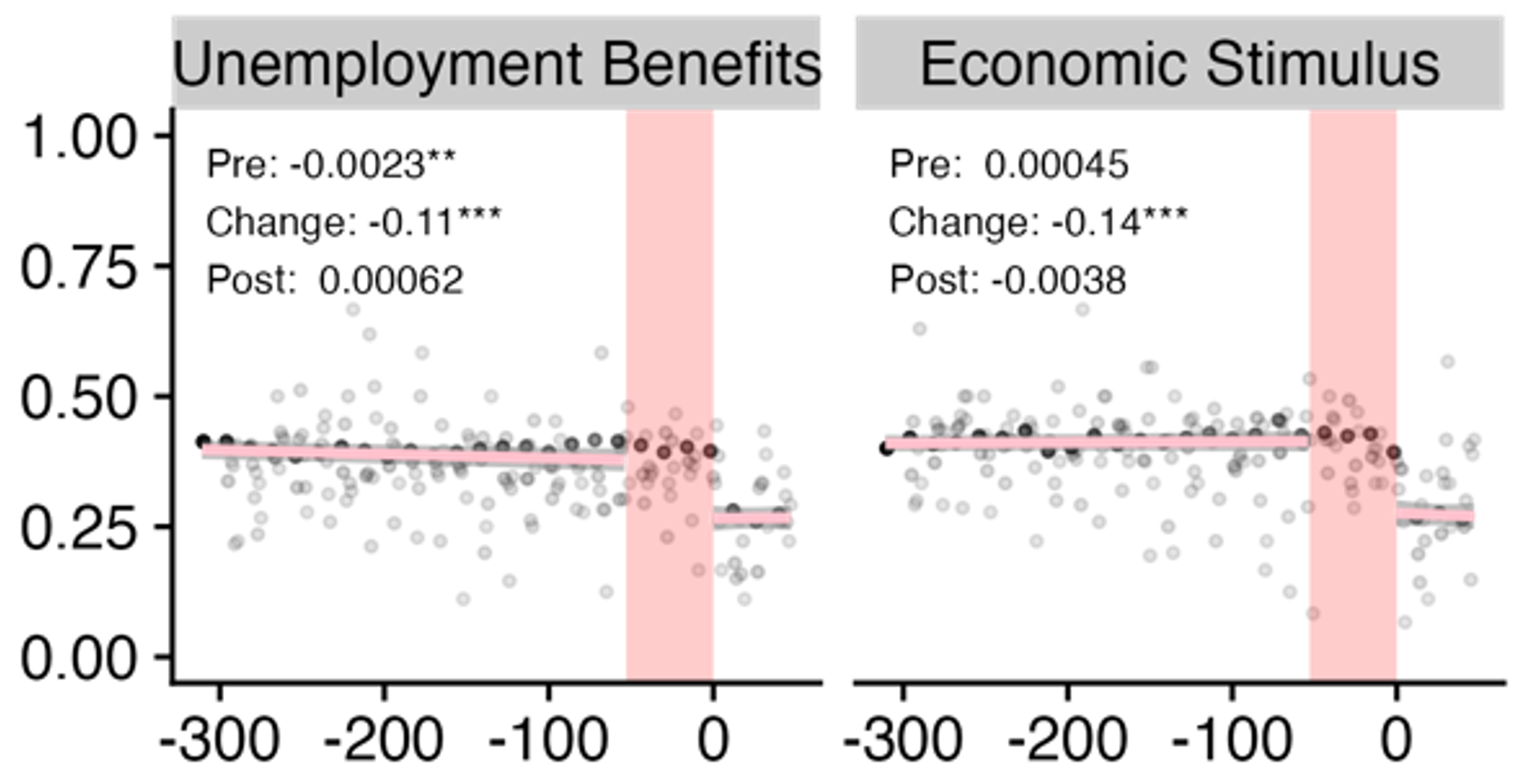
Figure S4 from Brandt et al., 2025

Figure S4 from Brandt et al., 2025

Adult political attitudes are highly stable (Brandt & Morgan, 2022; Turner-Zwinkels & Brandt, 2025), but they do change. What kinds of experiences cause attitude change? Do the same experiences change attitudes in the same way for everyone? Are experiences more impactful at certain points in our lives? Are some attitudes more likely to change in response to our experiences than others? How can we leverage life experiences to promote democratic resilience? These are the types of questions that we aim to answer in our projects.

For example, we conducted one of the most comprehensive assessments of political attitude change (in the USA) in response to the COVID-19 pandemic (Brandt et al., 2025). We found that the pandemic made people feel stressed out and worried about the economoy. However, most attitudes did not change. The only attitudes that meaningfully changed were those about the economy. That is, despite a historical, world altering event, most people didn’t change their minds about their political world.

Related publications

  • Brandt, M. J., Vallabha, S., & Turner-Zwinkels, F. (2025). The onset of the COVID-19 pandemic made people feel threatened, but had a limited impact on political attitudes in the United States. Personality and Social Psychology Bulletin, 51, 284-300. doi | pdf | code
  • Cassario, A. L. & Brandt, M. J. (2025). Testing theories of threat, conservatism, and individual difference: Little evidence of personality based individual differences in ideological responses to threat. Social Psychological and Personality Science, 16, 657-668. doi | pdf | code | data
  • Kesberg, R., Brandt, M. J., Easterbrook, M., Spruyt, B., & Turner-Zwinkels, F. (2024). Finding (dis-)advantaged system justifiers – A bottom-up approach to explore system justification theory. European Journal of Social Psychology, 54, 81-96. doi | pdf | code | data
  • Brandt, M. J. & Bakker, B. N. (2022). The complicated but solvable threat–politics relationship. Trends in Cognitive Sciences, 26, 368-370. doi | pdf
  • Brandt, M. J. & Bakker, B. N. (2022). Threat-politics perceptions are intertwined with emotional processes. Trends in Cognitive Sciences, 26, 733-734. doi | pdf
  • Brandt, M. J., Turner-Zwinkels, F. M., Karapirinler, B., van Leeuwen, F., Bender, M., van Osch, Y., & Adams, B. G. (2021). The association between threat and politics depends on the type of threat, the political domain, and the country. Personality and Social Psychology Bulletin, 47, 324-343. doi | pdf | code | data
  • Stavrova, O., Evans, A. M., & Brandt, M. J. (2021). Ecological dimensions explain the past, but do not predict future changes in trust. American Psychologist, 76, 983-996. doi | pdf | code | data
  • Brandt, M. J., Kuppens, T., Spears, R., Andrighetto, L., Autin, F., Babincak, P. … & Zimmerman, J. L. (2020). Subjective status and perceived legitimacy across countries. European Journal of Social Psychology, 50, 921-942. doi | pdf | code | data
  • Hofmann, W., Brandt, M. J., Wisneski, D. C., Rockenbach, B., & Skitka, L. J. (2018). Moral punishment in everyday life. Personality and Social Psychology Bulletin, 44, 1697-1711. doi | pdf | code | data
  • Brandt, M. J. & Reyna, C. (2017). Individual differences in the resistance to social change and acceptance of inequality predict system legitimacy differently depending on the social structure. European Journal of Personality, 31, 266-278. doi | pdf | code | data
  • Proulx, T. & Brandt, M. J. (2017). Beyond threat and uncertainty: The underpinnings of conservatism. Social Cognition, 35, 313-323 doi | pdf
  • Brandt, M. J., Henry, P. J., & Wetherell, G. (2015). The relationship between authoritarianism and life satisfaction changes depending on stigmatized status. Social Psychology and Personality Science, 6, 219-228. doi | pdf | code
  • Brandt, M. J., Wetherell, G., & Henry, P.J. (2015). Changes in income predict change in social trust: A longitudinal analysis. Political Psychology, 36, 761-768. doi | pdf | code
  • Hofmann, W., Wisneski, D. C., Brandt, M. J., & Skitka, L. J. (2014) Morality in everyday life. Science, 345, 1340-1343. doi | pdf | code | data
  • Brandt, M. J. (2013). Do the disadvantaged legitimize the social system? A large-scale test of the status-legitimacy hypothesis. Journal of Personality and Social Psychology, 104, 765-785. Footnote 7 Results| Footnote 9 Results | doi | pdf | code
  • Brandt, M. J. & Henry, P. J. (2012a). Gender inequality and gender differences in authoritarianism. Personality and Social Psychology Bulletin, 38, 1301-1315. doi | pdf
  • Brandt, M. J. (2011). Sexism and gender inequality across 57 societies. Psychological Science, 22, 1413 - 1418. doi | pdf